
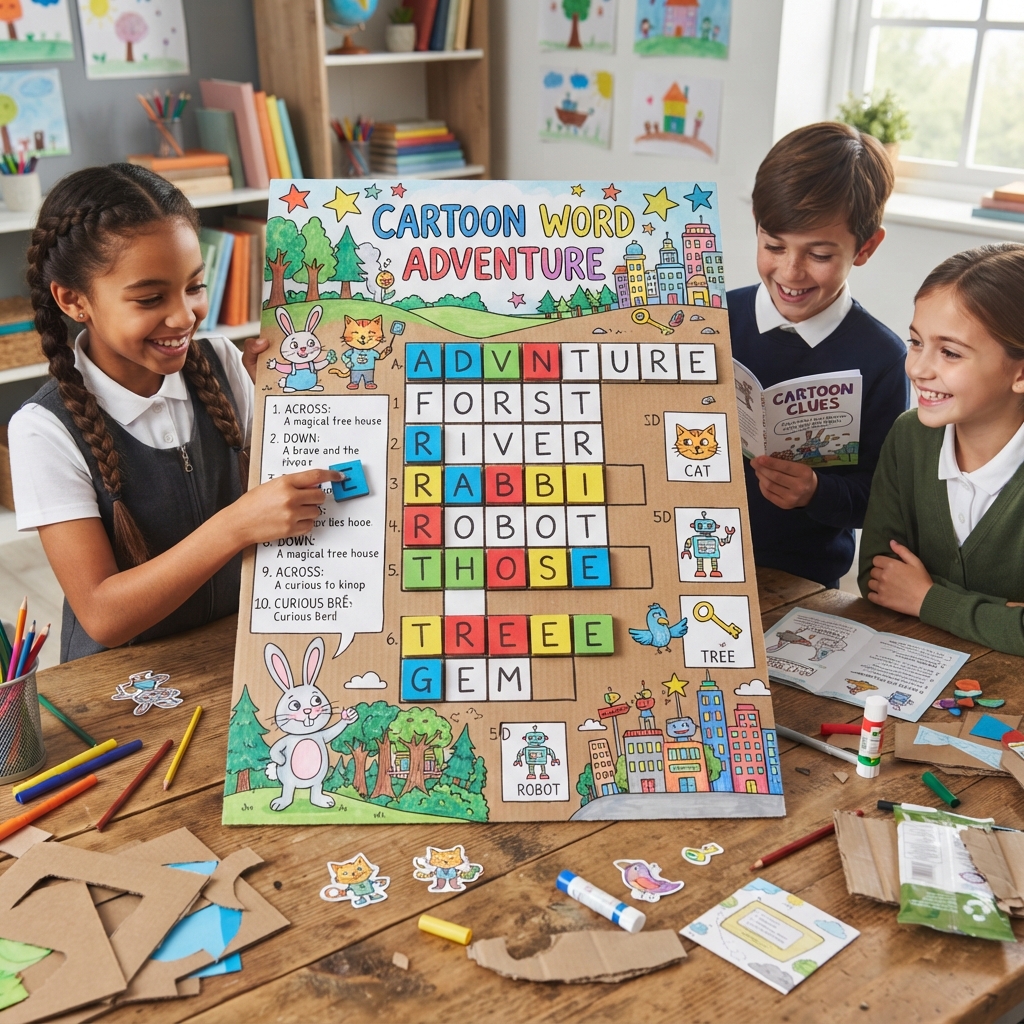
A cartoon-inspired word crossword game is a fun and creative educational activity that combines the excitement of cartoons with the mental challenge of solving a crossword puzzle. It can be designed for children, students, families, or classroom groups. Instead of using ordinary vocabulary, the crossword focuses on colorful cartoon-style characters, objects, places, actions, animals, and imaginative situations.
The activity can be created with simple materials such as cardboard, paper, pencils, colored markers, glue, and recycled packaging. A student can design a crossword grid, write clues, decorate the puzzle with cartoon illustrations, and turn the finished creation into an attractive educational game. It can be played individually or with classmates.
A cartoon-inspired crossword game is especially useful because it makes learning feel like play. Children are often attracted to colorful characters and imaginative stories. When these elements are combined with words and clues, students may become more interested in reading, spelling, vocabulary, and problem-solving.
The Basic Idea
A crossword game consists of a grid made of horizontal and vertical spaces. Players read clues and write the answers into the appropriate spaces.
In a cartoon-inspired version, every answer can be connected to a common theme. The theme could be a fictional cartoon world containing friendly animals, adventurous children, magical objects, funny vehicles, or imaginary places.
For example, clues might ask players to identify a character’s animal friend, a place where an adventure happens, or an object used during a mission.
The important point is that the crossword should remain educational while also being imaginative.
Choosing a Theme
The first step in creating the game is choosing a theme.
A student might choose “Funny Cartoon Animals,” “Adventure in Cartoon City,” “Magical School,” “Space Friends,” or “Underwater Cartoon World.”
A consistent theme helps the crossword feel like one complete game.
For younger children, an animal theme can be especially effective. Words such as CAT, DOG, LION, FISH, BIRD, and HORSE are easy to recognize.
Older students can use longer vocabulary words and more complicated clues.
Designing the Crossword Grid
Once the theme has been selected, the crossword grid can be planned.
A simple grid can be drawn on graph paper or directly onto cardboard.
Each square should be approximately the same size. Black squares can separate different words.
Students should first decide which words will be included. Then they can arrange the words so that some letters cross.
Crossing words are an important feature because they help players discover answers. If a student knows only part of a word, the letters from another answer can provide useful clues.
Creating the Cartoon Characters
The crossword can include original cartoon-style characters.
For example, students could invent a clever rabbit, a brave cat, a friendly robot, or a curious bird.
Each character can have a name and personality.
The character names can become crossword answers.
Small illustrations can be placed around the puzzle.
This makes the activity visually appealing and gives students an opportunity to combine drawing with language learning.
Writing the Clues
The clues are the heart of the crossword game.
They should be clear, interesting, and appropriate for the players’ age.
A simple clue might be:
“An animal that says meow.”
The answer would be CAT.
A more advanced clue might be:
“A person who explores strange and exciting places.”
The answer could be ADVENTURER.
Clues can be based on definitions, descriptions, pictures, actions, or short stories.
Picture Clues
Picture clues are particularly useful for young learners.
Instead of writing a long definition, the game can show a small cartoon picture.
A picture of a sun might represent the word SUN. A picture of a book could represent BOOK.
Picture clues help children connect visual information with vocabulary.
They also make the crossword look more like a cartoon activity.
Vocabulary Development
One of the biggest educational benefits of a cartoon crossword game is vocabulary development.
Students encounter new words through clues and answers.
They learn spelling while also learning the meaning of words.
Teachers can choose vocabulary from a current lesson and incorporate those words into the crossword.
For example, a lesson about nature could include words such as FOREST, RIVER, TREE, FLOWER, CLOUD, and ANIMAL.
The cartoon theme makes these words more memorable.
Spelling Practice
Crossword puzzles naturally encourage spelling practice.
Players must write each answer letter by letter and make sure that it fits the grid.
If a word is spelled incorrectly, it may conflict with another word.
This gives students immediate feedback.
Instead of memorizing spelling through repetition alone, children use spelling as part of a problem-solving activity.
Reading Practice
To solve the crossword, students must carefully read and understand the clues.
This develops reading comprehension.
Teachers can gradually increase the difficulty of the clues.
For younger learners, clues can be short and direct.
For older students, clues can include descriptions, synonyms, or short sentences.
This allows the same basic game format to support different reading levels.
A Story-Based Crossword
A more advanced version can connect the crossword to a short cartoon story.
For example, imagine a group of cartoon friends traveling through a magical forest.
The crossword clues could refer to objects and places from their adventure.
One clue might ask for the name of the vehicle they use. Another could describe an animal they meet.
As students solve the crossword, they gradually discover the important words from the story.
This combines reading, vocabulary, imagination, and puzzle solving.
Creating a Cartoon School
A school-themed crossword can be especially appropriate for classroom use.
The cartoon characters can be students attending an imaginary school.
Words might include CLASSROOM, TEACHER, BOOK, PENCIL, DESK, BAG, BOARD, and FRIEND.
Each word can have a clue.
The puzzle can be decorated with miniature cartoon students, school buildings, desks, and books.
This creates a strong connection between the game and everyday school life.
Making the Game from Cardboard
A cardboard crossword is a great craft project.
A large piece of cardboard can be used as the base.
The crossword grid can be drawn using a ruler and marker.
Black paper can cover the unused squares, while white squares remain available for answers.
The edges can be decorated with colorful paper.
A title such as “Cartoon Word Adventure” can be placed at the top.
The finished game can be displayed on a classroom wall or used on a table.
Using Recycled Materials
Recycled materials can make the project inexpensive and environmentally friendly.
Old cardboard boxes can become the game board.
Paper scraps can be used for cartoon decorations.
Packaging materials can be cut into small cards for clues.
This teaches students that creative educational games can be made from everyday objects.
Recycling also provides an opportunity to discuss environmental responsibility.
Making Removable Letter Cards
An interactive version can use removable letters.
Instead of writing answers directly into the crossword, students can place individual letter cards into the squares.
This allows the game to be reused.
The letters can be made from small pieces of cardboard or paper.
For younger children, the teacher can provide a collection of letters and ask students to build the answers using the available pieces.
Creating a Magnetic-Style Version
A cardboard board can also imitate a magnetic crossword.
Small letter tiles can be attached using reusable adhesive or another appropriate classroom-safe method.
Students can move the letters around until they find the correct arrangement.
This makes the puzzle more interactive.
The magnetic-style design also helps students understand that words are made from letters arranged in a specific order.
Playing Individually
The simplest way to play is individually.
Each student receives a copy of the crossword and a pencil.
They read the clues and try to complete the grid.
Students can work at their own pace.
This format is useful for quiet classroom activities or independent learning.
Playing in Teams
The crossword can also become a team game.
Students can be divided into small groups.
The teacher reads a clue, and each team discusses the possible answer.
The first team to identify the correct word can place it on their board.
Alternatively, each team can receive its own crossword and race to complete it accurately.
Team play encourages communication and cooperation.
Timed Challenges
A timed version can add excitement.
Students can be given a specific amount of time to solve as many clues as possible.
However, the purpose should be to encourage concentration rather than create excessive pressure.
Teachers can also allow students to work together and focus on accuracy.
The challenge can be repeated later to see whether students improve.
Different Difficulty Levels
A good crossword game can have multiple levels.
A beginner puzzle might contain short words with picture clues.
An intermediate puzzle could use definitions and simple descriptions.
An advanced crossword could contain longer words, synonyms, word relationships, and more complicated clues.
This allows the activity to grow with the learners.
Learning Grammar
The crossword can also support grammar.
For example, clues can ask for nouns, verbs, adjectives, or plural forms.
A clue might say, “A word that describes something very large.”
The answer could be BIG.
Another clue could ask for a verb meaning “to move quickly.”
The answer might be RUN.
Grammar-based clues make the game useful beyond simple vocabulary practice.
Using Synonyms and Antonyms
Synonyms and antonyms can create more challenging clues.
For example:
“Another word for happy.”
The answer could be GLAD.
An antonym clue might ask:
“Opposite of hot.”
The answer would be COLD.
These clues help students develop a richer understanding of language.
Including Mathematics
Although the game focuses on words, mathematics can also be incorporated.
Some clues can involve numbers.
For example, a clue might say, “The number after nine.”
The answer would be TEN.
Another clue could ask for the result of a simple calculation.
This creates an interdisciplinary puzzle combining language and mathematics.
Creating a Cartoon Treasure Hunt
The crossword can become part of a larger treasure hunt.
Each completed answer can provide a letter or number.
When students finish the puzzle, they use those special letters to discover a secret message.
The message might reveal where a small classroom prize or hidden picture is located.
This adds another layer of problem-solving.
Encouraging Creativity
Students can eventually create their own cartoon crossword games.
They can invent characters, choose vocabulary, write clues, and design the grid.
Creating the puzzle may be more challenging than solving one.
It requires students to think about word meanings, spelling, relationships between words, and clear communication.
This makes puzzle creation an excellent advanced learning activity.
Social and Emotional Learning
Cartoon characters can also be used to explore emotions and positive behavior.
The crossword could contain words such as KIND, HAPPY, BRAVE, FRIENDLY, HELPFUL, and HONEST.
The clues can describe positive behaviors.
For example, “Someone who helps others is ____.”
The answer might be HELPFUL.
This allows the activity to support social and emotional learning.
Benefits of the Cartoon Crossword
The cartoon-inspired crossword game offers many benefits.
It improves vocabulary, spelling, reading, memory, and concentration.
It also encourages logical thinking because students must determine how words fit together.
The visual elements support learners who respond well to pictures.
The craft component develops creativity and fine motor skills.
Group play improves communication and cooperation.
Most importantly, the activity creates a positive learning environment where students can practice important skills through play.
Tips for Making a Successful Game
The crossword should not be too difficult for the intended players.
Words should match the students’ vocabulary level.
The grid should be large enough to read easily.
Clues should be written clearly.
If the game is designed for young children, pictures should be included.
The cartoon decorations should support the theme without making the puzzle difficult to understand.
Teachers should also test the crossword before presenting it to students to make sure all words fit correctly.
Conclusion
A cartoon-inspired word crossword game is an imaginative way to combine education and entertainment. By bringing together colorful characters, creative stories, vocabulary, clues, and a crossword grid, the activity can turn language practice into an exciting adventure.
Students can use the game to develop spelling, reading, vocabulary, grammar, memory, concentration, and problem-solving skills. Younger children can work with pictures and simple words, while older learners can solve more challenging clues involving definitions, synonyms, antonyms, and story-based vocabulary.
The game can be created from inexpensive and recycled materials such as cardboard, paper, and markers. Students can also participate in designing the characters, writing the clues, and decorating the board.
Whether it is played individually, in pairs, or in teams, a cartoon-inspired crossword provides an engaging learning experience. It shows that educational activities do not need to be complicated or expensive. With a few words, a creative theme, and a little imagination, an ordinary crossword can become a colorful cartoon adventure that encourages children to learn, think, create, and have fun.
