
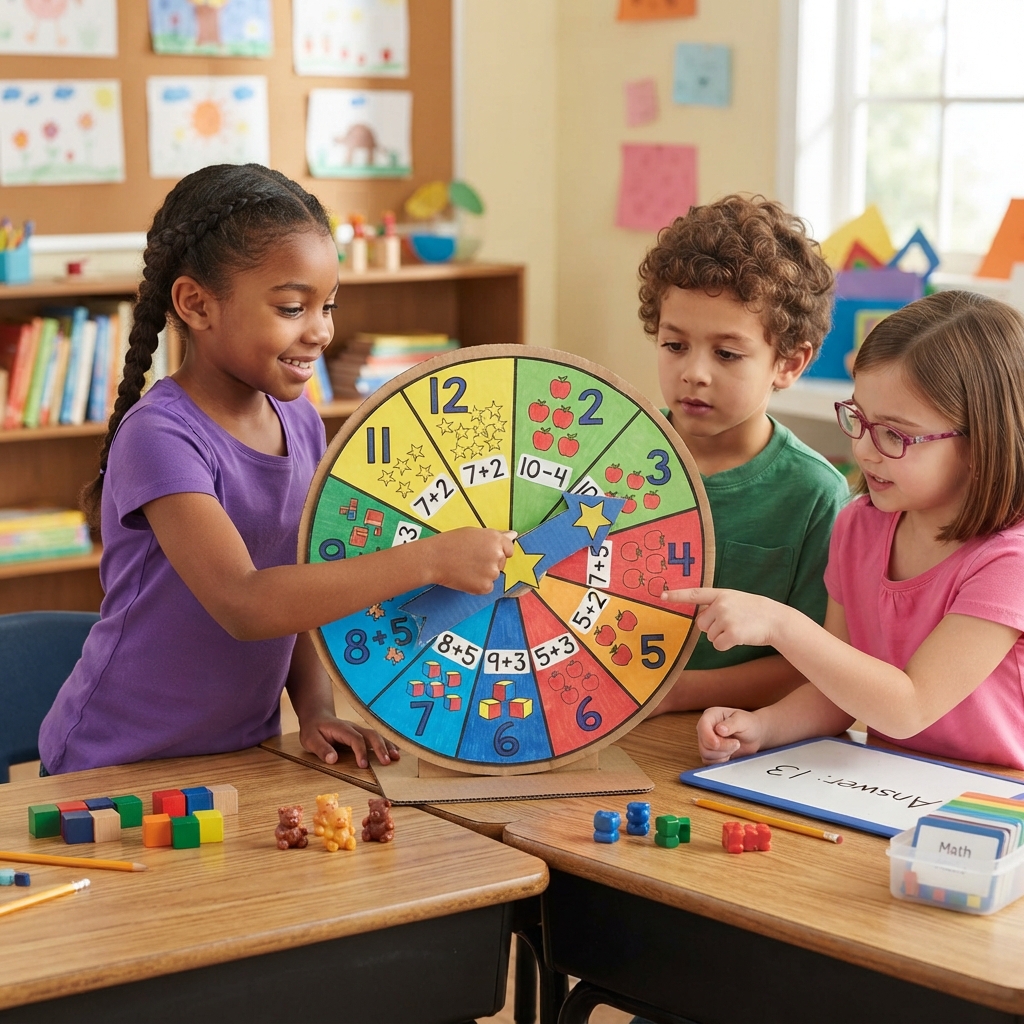
Learning mathematics can sometimes be difficult for children. Numbers, counting, addition, subtraction, multiplication, division, and other mathematical concepts may seem complicated when they are introduced only through textbooks and written exercises. For this reason, teachers and parents are always looking for creative ways to make mathematics easier, more enjoyable, and more interactive. One simple but powerful idea is the educational number wheel.
An educational number wheel is a circular learning tool that contains numbers, mathematical symbols, pictures, questions, or activities. Children can spin the wheel and use the number or challenge selected by the arrow to complete an activity. It can be made from cardboard, paper plates, foam board, recycled materials, or other inexpensive supplies. Because it is colorful, hands-on, and easy to use, the number wheel can transform ordinary mathematics practice into an exciting game.
The educational number wheel is more than a classroom decoration. It can support different learning levels and be adapted to many mathematical topics. Young children can use it to practice counting and recognizing numbers, while older students can use it for addition, subtraction, multiplication, division, fractions, problem-solving, and mental mathematics. The wheel can also encourage students to participate actively instead of simply listening to explanations.
What Is an Educational Number Wheel?
An educational number wheel is a rotating circular board designed to help children learn numbers and mathematics through play. It usually consists of a large circle divided into several sections. Each section contains a number, mathematical operation, question, picture, or learning instruction. A movable pointer in the center indicates the selected section when the wheel stops spinning.
For example, a simple wheel might contain the numbers 1 to 10. A teacher can ask a child to spin the wheel and then count objects according to the number selected. Another wheel might contain addition problems. If the arrow points to “7 + 4,” the student must calculate the answer. A multiplication wheel could contain different multiplication facts, while a fraction wheel could show fractions that students must identify or compare.
The design can be changed according to the age and ability of the learners. This flexibility makes the educational number wheel useful in homes, preschools, elementary classrooms, tutoring centers, and educational activity clubs.
Why Use a Number Wheel for Learning?
One of the greatest advantages of the educational number wheel is that it makes learning active. Instead of simply writing answers on a worksheet, children physically interact with the learning material. They spin, observe, think, answer, and sometimes explain their reasoning.
This type of activity can make students more interested in mathematics. A colorful wheel creates an element of surprise because children do not know which number or question they will receive. This can turn repetitive practice into a small challenge or game.
The wheel can also reduce the fear that some children have about mathematics. When mathematical activities are presented as games, students may feel less pressure. They can make mistakes, try again, and learn from the experience.
Another important benefit is repetition. Mathematics requires practice, and children often need to solve similar problems many times before they become confident. A number wheel allows teachers to repeat skills without making every activity feel exactly the same.
Materials Needed to Make a Number Wheel
One reason the educational number wheel is popular is that it does not require expensive materials. A basic version can be created with simple items found at home or in a classroom.
Useful materials include:
- A piece of strong cardboard
- Colored paper
- A ruler
- A pencil
- Scissors
- Markers or crayons
- A compass or round plate for drawing a circle
- Glue
- A paper fastener or split pin
- A small arrow made from cardboard
- Decorative stickers
Teachers and parents can also reuse cardboard boxes, old folders, cereal boxes, or paper plates. Reusing materials makes the project inexpensive and introduces children to the idea of recycling.
How to Make an Educational Number Wheel
Making a number wheel can itself become an educational activity. First, draw a large circle on a piece of cardboard. A plate can be placed on the cardboard and traced around to create a neat circular shape.
Next, divide the circle into equal sections. For a beginner wheel, eight or ten sections may be enough. A ruler can be used to draw lines from the center of the circle toward the outside edge.
After dividing the wheel, write numbers or mathematical activities in the sections. For example, a basic counting wheel could include the numbers 1 through 10. Different colors can be used to make the sections easier to recognize.
Then create a small arrow from another piece of cardboard. Attach the arrow to the center of the wheel using a paper fastener. The arrow should be able to move freely while the wheel remains stable.
Finally, decorate the wheel with simple educational images. Stars, pencils, books, shapes, animals, or smiling faces can make the wheel more attractive to children. However, the design should remain clear so that decoration does not make the numbers difficult to read.
Number Recognition Activities
For young learners, number recognition is one of the easiest ways to use an educational number wheel. The wheel can contain numbers from 1 to 10 or from 1 to 20.
The teacher can ask the child to spin the wheel and identify the number selected. The child can then say the number aloud, write it on paper, or find a matching number card.
Another activity involves counting. If the wheel lands on the number six, the child can be asked to place six blocks on a table. If it lands on nine, the child can count nine buttons, beads, pencils, or toy objects.
This simple exercise connects written numbers with real quantities. Children gradually understand that a symbol such as “6” represents a specific amount.
Addition and Subtraction Games
The educational number wheel can also be used to practice addition and subtraction. A teacher can create two smaller wheels: one containing numbers and another containing numbers or mathematical symbols.
For example, a student can spin the first wheel and get the number five. The student then spins the second wheel and gets three. The task is to calculate five plus three.
A single wheel can also contain complete equations such as:
- 2 + 5
- 4 + 3
- 8 − 2
- 10 − 6
- 7 + 1
Students spin the wheel, solve the selected problem, and explain their answer.
To make the game more challenging, students can earn points for correct answers. However, the focus should remain on learning rather than competition. The goal is to help children become comfortable with numbers.
Multiplication Practice
Older children can use the educational number wheel to practice multiplication tables. Each section can contain a multiplication problem such as “3 × 4,” “6 × 7,” or “8 × 5.”
A student spins the wheel and solves the selected problem. If the answer is correct, the student receives a point or moves forward on a simple classroom game board.
Teachers can also create separate wheels for different multiplication tables. One wheel might focus on the two-times table, while another focuses on five, six, or ten. This allows students to practice one skill at a time.
The playful format can make memorizing multiplication facts less repetitive. Students receive immediate practice and can repeat the activity several times.
Fractions and Decimals
The number wheel can be adapted for more advanced mathematics. For example, sections can contain fractions such as 1/2, 1/3, 1/4, and 3/4. Students can identify the fractions, compare them, or match them with pictures.
A wheel designed for decimals might contain numbers such as 0.5, 0.25, 1.5, and 2.75. Students can be asked to read the numbers aloud, convert them into fractions, or place them in order from smallest to largest.
This demonstrates that one basic learning tool can be adapted as students develop new mathematical skills.
Problem-Solving Activities
Mathematics is not only about calculating numbers. Students also need to learn how to use mathematics to solve everyday problems. The educational number wheel can introduce simple word problems.
For example, one section might say:
“Sarah has 8 apples and gives 3 to her friend. How many apples does she have left?”
Another section might ask:
“There are 4 boxes with 5 pencils in each box. How many pencils are there altogether?”
Students spin the wheel, read the problem, identify the mathematical operation needed, and solve it.
This activity develops reasoning skills because children must understand the situation before calculating the answer.
The Role of Colors and Pictures
Colors and pictures can make the educational number wheel more attractive, especially for younger children. Different colors can represent different types of activities.
For example, blue sections could represent addition, green sections could represent subtraction, yellow sections could represent multiplication, and purple sections could represent counting.
Pictures can also support children who are still developing reading skills. A section containing the number “4” could include four apples or four stars. Children can connect the visual representation with the written number.
However, teachers should avoid overcrowding the wheel. Clear numbers and simple illustrations are usually more effective than excessive decoration.
Social Learning and Group Activities
The educational number wheel can be used individually or in groups. In a classroom, several students can sit around a table and take turns spinning the wheel.
One student spins while another solves the problem. A third student can check the answer. Then they change roles.
This encourages communication and cooperation. Children can explain how they reached an answer and listen to different methods used by their classmates.
Group activities can also help shy students become more involved. Since the wheel creates a playful environment, participation may feel less intimidating than answering a question in front of the entire class.
Developing Fine Motor Skills
Although the main purpose of the number wheel is mathematical learning, it can also support physical development. Children use their hands to spin the wheel, move the pointer, point to numbers, write answers, and manipulate learning objects.
Young children benefit from these small movements because they help develop hand-eye coordination and fine motor control.
Making the wheel can also be a craft activity. Cutting cardboard, drawing shapes, coloring sections, and attaching the pointer require concentration and coordination.
Supporting Different Learning Styles
Every child learns differently. Some children understand mathematical ideas more easily when they see them, while others learn better through movement, conversation, or repeated practice.
The educational number wheel combines several approaches. Children can see numbers and pictures, physically spin the wheel, hear questions from the teacher, and explain their answers aloud.
Because the tool can be modified easily, teachers can design activities that suit different learners. A visual learner may benefit from pictures, while an active learner may enjoy spinning the wheel and moving objects to represent numbers.
Using the Number Wheel at Home
Parents can use an educational number wheel for short mathematics sessions at home. It does not need to become a formal lesson. Ten or fifteen minutes of playful practice can be enough to reinforce skills learned at school.
Parents can ask children to spin the wheel after homework or during a family game session. Younger children can practice counting toys, while older children can solve multiplication problems.
The wheel can also become a family activity. Parents and children can take turns creating questions and checking answers. This creates opportunities for learning while spending time together.
Adapting the Wheel to Other Subjects
Although the educational number wheel is mainly associated with mathematics, the same concept can be adapted to other subjects.
A language wheel could contain letters, vocabulary words, or sentence-building challenges. A science wheel could include questions about animals, plants, weather, or the human body. A geography wheel could contain countries, continents, and capital cities.
This demonstrates the flexibility of the wheel as a general educational game. The circular design can be reused for many different learning objectives.
Keeping Children Motivated
Motivation is an important part of learning. Children are more likely to practice a skill when they enjoy the activity. The educational number wheel provides variety and surprise, which can help maintain attention.
Teachers can introduce small challenges such as “Solve three problems correctly” or “Explain your answer to a partner.” Rewards do not have to be material. A point, sticker, encouraging word, or classroom achievement can be enough.
Most importantly, mistakes should be treated as part of learning. If a child gives an incorrect answer, the teacher can ask guiding questions instead of immediately providing the solution.
Conclusion
The educational number wheel is a simple, inexpensive, and creative tool that can make mathematics more enjoyable for children. It transforms numbers and mathematical problems into an interactive experience where students can spin, discover, calculate, discuss, and learn.
Its greatest strength is its flexibility. A basic number wheel can teach counting and number recognition, while more advanced versions can support addition, subtraction, multiplication, division, fractions, decimals, and problem-solving. It can also encourage cooperation, communication, concentration, and fine motor skills.
Another advantage is that children can participate in making the wheel themselves. Creating the learning tool becomes part of the educational experience, combining creativity with mathematics.
In a world where educational technology is becoming increasingly common, simple hands-on materials still have an important place in learning. An educational number wheel proves that effective teaching does not always require expensive equipment. With cardboard, colors, numbers, and a little imagination, teachers and parents can create an engaging activity that turns mathematics into a game.
Ultimately, the educational number wheel is not simply a spinning circle. It is a practical learning tool that encourages curiosity, repetition, active participation, and confidence. By presenting mathematics in a playful and accessible way, it can help children discover that numbers are not something to fear but something they can explore, understand, and enjoy.
