
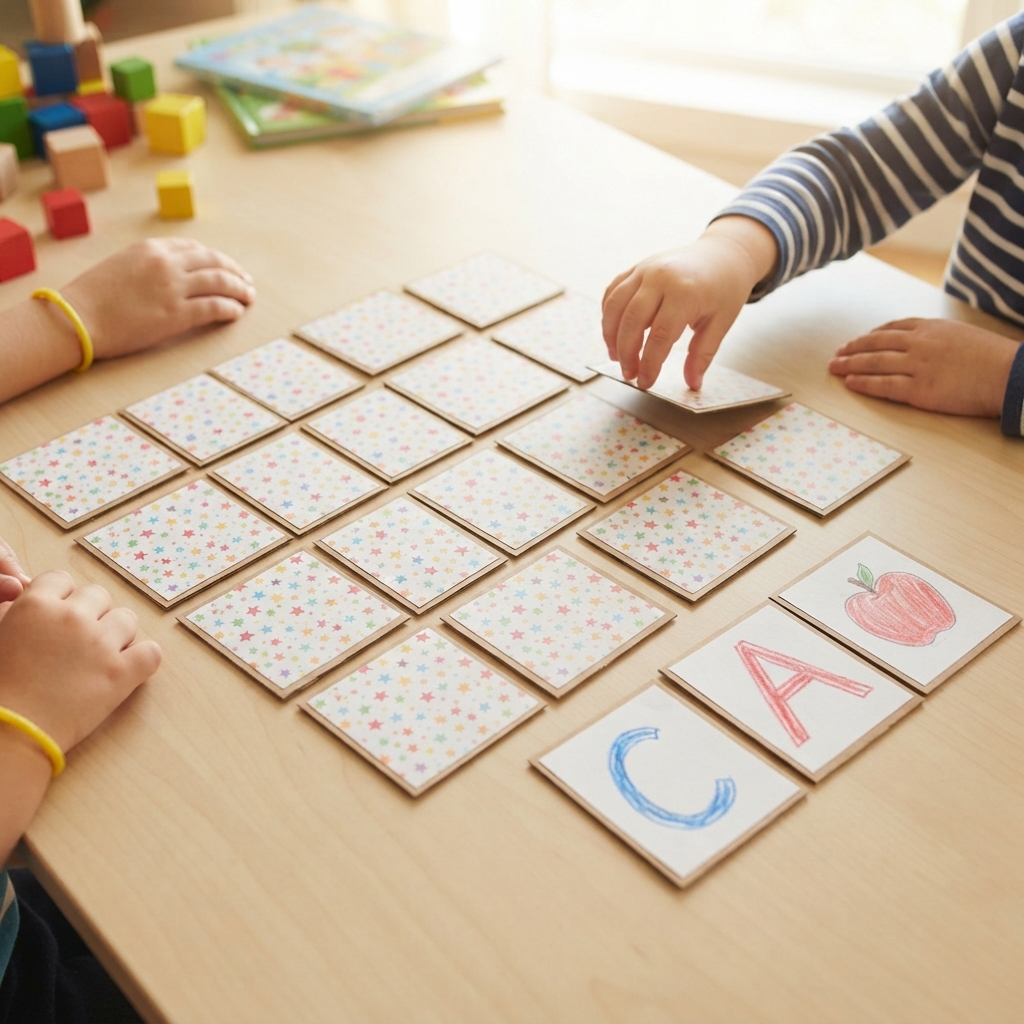
Learning can become much more enjoyable when children are given opportunities to play, explore, and discover new ideas. Educational games are especially useful because they combine learning with entertainment. One simple activity that can support children’s memory, language, concentration, and visual recognition is a memory game using letters and pictures.
A memory game using letters and pictures is a simple educational activity in which children match letters with pictures, remember the locations of cards, and find pairs. For example, one card may show the letter “A,” while another card displays an apple. The child must remember that the letter A is connected to the picture of an apple. Other combinations might include “B” with a ball, “C” with a cat, or “D” with a dog.
The game can be made from cardboard, paper, recycled materials, or printable cards. It can be used at home, in preschool, elementary classrooms, libraries, and educational activity centers. Although the rules are simple, the game can provide many learning benefits. It encourages children to concentrate, remember information, recognize letters, connect sounds with objects, and develop early reading skills.
What Is a Letter and Picture Memory Game?
A letter and picture memory game is a matching activity based on memory and visual association. The game normally uses a collection of cards placed face down on a table. Some cards contain letters, while others contain pictures that represent words beginning with those letters.
For example, the cards might include:
- A — Apple
- B — Ball
- C — Cat
- D — Dog
- E — Elephant
- F — Fish
The cards are mixed and placed face down. Players take turns turning over two cards. If the letter and picture match, the player keeps the pair. If they do not match, the cards are turned face down again, and the next player takes a turn.
The game combines two types of memory. Children need to remember where different cards are located, and they also need to remember the relationship between a letter and a picture. This makes the activity both entertaining and educational.
Materials Needed
One of the best features of this activity is that it requires very few materials. Parents and teachers can make a complete game using items they already have.
The basic materials include:
- Thick cardboard or cardstock
- White paper
- Colored pencils or markers
- Scissors
- Glue
- Ruler
- Simple drawings or printed pictures
- Optional stickers for decoration
Old cereal boxes and other clean cardboard packaging can be reused to make stronger cards. Reusing materials can make the project inexpensive while also teaching children about recycling.
For younger children, the cards should be large enough to handle easily. The letters should be clear and bold, while the pictures should be simple and recognizable.
How to Make the Cards
Making the cards is a straightforward process. First, cut several pieces of cardboard into equal-sized rectangles. Keeping all cards the same size makes the game more organized.
Next, prepare the letter cards. Write one large uppercase letter in the center of each card. Depending on the children’s age, lowercase letters can also be included.
Then prepare the picture cards. Each picture should represent a familiar word beginning with one of the letters. For example, the letter “M” could be matched with a picture of a moon, while “S” could be matched with a picture of a sun.
The back of every card should look identical. This is important because players should not be able to identify a card before turning it over.
Finally, decorate the cards if desired. A colorful border can make them attractive, but the design should not make the letters or pictures difficult to see.
How to Play the Game
The rules are simple enough for young children to understand.
First, place all the cards face down on a table. Mix them carefully so nobody knows where the pairs are located.
The first player chooses one card and turns it over. The player then chooses a second card and turns it over.
If the two cards form a correct letter-picture pair, the player keeps them and receives another turn. If the cards do not match, both cards are turned face down again.
The next player then takes a turn.
The game continues until all pairs have been found. The player with the greatest number of pairs can be declared the winner, although teachers may choose to focus on learning rather than competition.
For very young children, adults can help by saying the letter and the picture name aloud.
Developing Memory Skills
The most obvious benefit of this game is memory development. Children need to remember where they have seen particular cards. If a child discovers a picture of a cat in one location and later remembers where the letter C is located, the child can use that information to make a successful match.
Repeated play strengthens this process. Children gradually become better at remembering card locations and recognizing patterns.
Memory is important in many areas of education. Students need memory skills to remember vocabulary, mathematical facts, scientific concepts, instructions, and information from books. A simple memory game can therefore support a broader learning ability.
Improving Letter Recognition
Letter recognition is an important early literacy skill. Before children can read words fluently, they need to recognize letters quickly and accurately.
A memory game provides repeated exposure to letters in an enjoyable context. Instead of looking at a letter only on a worksheet, children interact with it during a game.
For example, a child who repeatedly sees the letter B while matching it with a ball gradually becomes more familiar with its shape. Teachers can pronounce the letter at the same time, creating an additional connection between its visual form and sound.
Over time, children can become more confident in identifying uppercase and lowercase letters.
Connecting Letters With Sounds
The game can also be used to introduce phonics. When a child finds the letter “D” and a picture of a dog, the teacher can say the word slowly and emphasize the beginning sound.
For example:
“D is for dog. Dog starts with the /d/ sound.”
This creates a connection between the written symbol, the spoken sound, and the object represented by the picture.
The same technique can be applied to every pair. Children gradually begin to understand that letters represent sounds and that sounds are combined to form words.
Expanding Vocabulary
Pictures provide an excellent opportunity to introduce new vocabulary. While young children may already know common words such as cat, dog, and ball, teachers can introduce less familiar words as children become more advanced.
For example, a picture representing the letter “G” might show a giraffe. A picture for “K” could show a kite, while “T” could represent a turtle.
After a child finds a pair, the teacher can ask questions such as:
“What is this?”
“What letter does it begin with?”
“Can you say the word?”
“Can you use the word in a sentence?”
These additional questions turn a simple matching game into a language-learning activity.
Improving Concentration
Children must pay attention to the cards that other players reveal. Even when it is not their turn, they need to observe carefully because another player may accidentally reveal a card they will need later.
This encourages children to remain focused throughout the activity.
Concentration is especially important for school success. Students need to pay attention during lessons, follow instructions, read carefully, and complete tasks without becoming distracted. Games that encourage sustained attention can provide useful practice.
Developing Visual Recognition
The picture cards encourage children to observe shapes, colors, objects, and details. They learn to recognize the difference between similar images and identify important visual features.
Teachers can make the game more challenging by using pictures that are visually similar. For example, they could include a picture of a rabbit and a hare or different types of flowers.
For beginners, however, clear and familiar images are preferable. The purpose is to create successful letter-picture associations rather than confusion.
Encouraging Social Interaction
A memory game can be played individually, but it becomes particularly useful as a small-group activity. Children learn to take turns, follow rules, wait patiently, and respect other players.
They also communicate with one another. A child might say, “I remember the apple was over there,” or celebrate when another child discovers a pair.
These interactions develop social skills alongside academic skills.
Teachers can use the game to encourage positive behavior. Children can be reminded to congratulate one another, help classmates when appropriate, and accept mistakes calmly.
Adapting the Game for Different Ages
The game can easily be adjusted according to children’s abilities.
For preschool children, the game might contain only five or six pairs. The pictures should be familiar, and the teacher can pronounce each word aloud.
For early elementary students, more pairs can be introduced. Uppercase and lowercase letters can be mixed so that children learn to recognize both forms.
More advanced students can match letters with complete words instead of pictures. For example, one card could show the letter “B,” while another says “butterfly.”
Teachers can also introduce cards with beginning sounds, rhyming words, or simple spelling challenges.
Adding a Mathematical Element
Although the main focus is literacy, the game can include mathematics. Children can count the number of pairs they have collected. They can compare scores and determine who has more or fewer cards.
Older students can calculate the difference between two players’ scores.
For example, if one player has eight pairs and another has five, the teacher can ask:
“How many more pairs does the first player have?”
This creates a natural opportunity for simple subtraction.
Making the Game More Challenging
Once children understand the basic game, several variations can make the activity more difficult.
One variation is to increase the number of cards. More cards mean more locations to remember.
Another variation is to introduce a time limit. Children might have one minute to find as many correct pairs as possible.
Teachers can also create three-card matches. For example, one card might contain a letter, another a picture, and the third the written word. Children must find all three.
Another variation involves spelling. After finding a letter-picture pair, the child must spell the picture’s word correctly.
Using Technology Alongside the Physical Game
Although a physical memory game provides important hands-on learning, technology can also be used as a complementary tool. Teachers can create digital versions of matching activities on interactive classroom devices.
However, physical cards offer special advantages. Children can touch, move, turn, and organize the cards themselves. This creates a multisensory learning experience.
A balanced approach can therefore combine traditional games with digital activities. The physical game can be used for group interaction, while digital exercises can provide additional individual practice.
Using Recycled Materials
Creating the game from recycled materials can become a lesson in environmental responsibility. Cardboard boxes, old folders, and used packaging can be transformed into useful educational cards.
Children can participate in collecting safe recyclable materials and decorating them.
This approach teaches an important message: educational resources do not always need to be purchased. Creativity and imagination can transform ordinary household materials into valuable learning tools.
The Role of the Teacher or Parent
Adults play an important role in making the game educational. They can observe children’s progress, provide encouragement, correct pronunciation, and introduce new vocabulary.
Instead of simply announcing whether an answer is correct, adults can ask guiding questions.
For example, if a child sees the letter P and a picture of a panda, the adult might ask:
“What sound do you hear at the beginning of panda?”
This encourages the child to think rather than simply memorize the answer.
Adults should also adjust the difficulty when necessary. If children become frustrated, fewer cards can be used. If the game becomes too easy, additional pairs or new challenges can be introduced.
Emotional and Cognitive Benefits
Educational games can also support children’s confidence. Successfully remembering a card location or finding a correct pair gives children a sense of achievement.
Small successes can encourage them to keep trying even when a challenge becomes difficult.
The game also develops decision-making. Children must decide which card to turn over and remember information from previous turns. They learn that careful observation can lead to better results.
These cognitive skills can support learning beyond the game itself.
Conclusion
A memory game using letters and pictures is a simple yet powerful educational activity. It combines play with important early learning skills, including memory, concentration, letter recognition, phonics, vocabulary, visual recognition, and communication.
The game is inexpensive and easy to create. With cardboard, paper, markers, and familiar pictures, parents and teachers can build a personalized learning resource suitable for different ages and abilities.
Its greatest strength is its flexibility. Young children can begin by matching simple letters and pictures, while older learners can progress to words, sounds, spelling, and more complex challenges. The game can also incorporate counting, mathematics, teamwork, and environmental education.
Most importantly, the activity makes learning enjoyable. Children are not simply memorizing letters from a worksheet; they are actively searching, remembering, matching, speaking, and interacting. They learn through movement, observation, repetition, and play.
In an educational environment, games should not replace teaching, but they can make teaching more effective and engaging. A letter and picture memory game demonstrates how a simple idea can support many areas of child development. With creativity and thoughtful design, this activity can become a valuable part of a child’s learning journey, helping children build strong foundations for reading while developing the confidence and curiosity they need to become enthusiastic learners.
