Learning colors is one of the first important steps in a child’s early education. Young children see colors everywhere: in toys, clothes, flowers, animals, books, food, and nature. However, recognizing and naming colors does not always happen automatically. Children need opportunities to observe colors, compare them, name them, and use them in meaningful activities. One simple and creative educational tool that can make this process easier is the color learning disc.
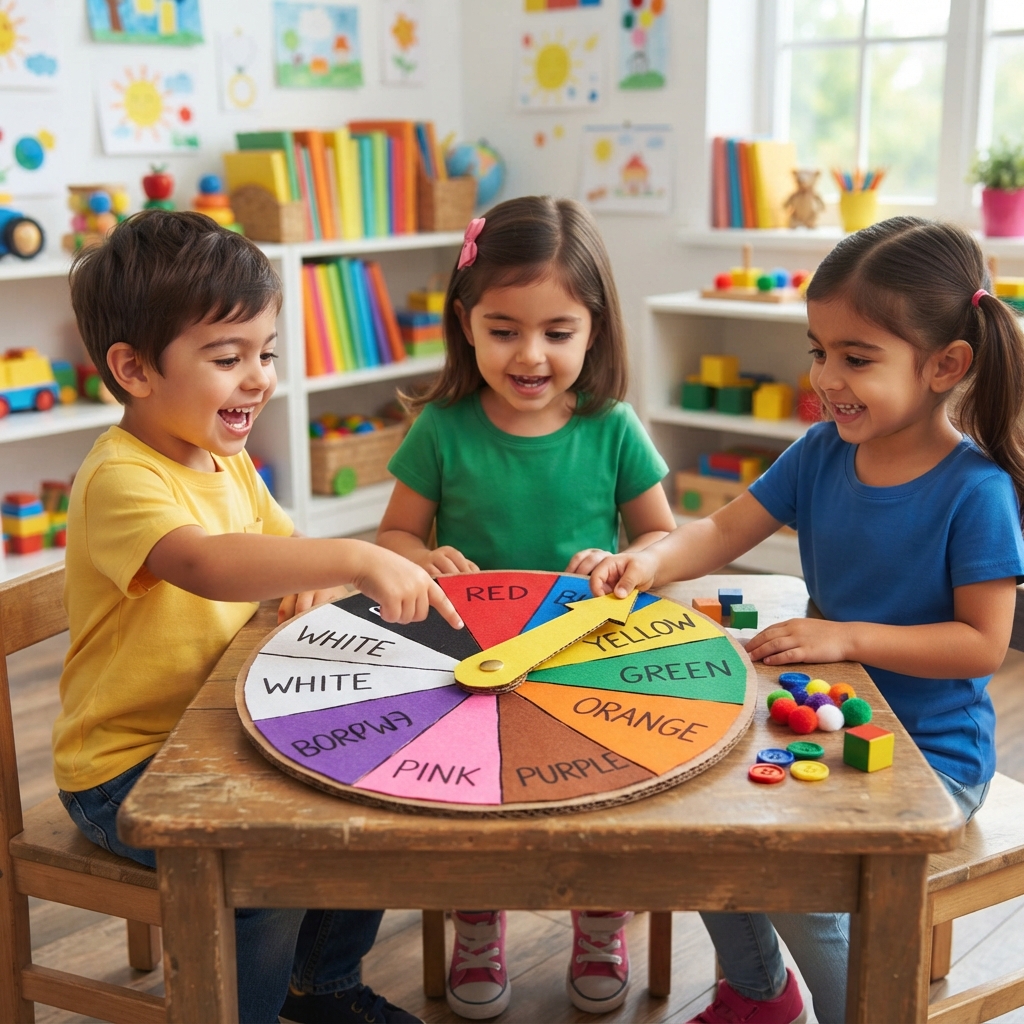
A color learning disc is a circular educational activity designed to help children recognize, name, compare, and organize different colors. It can be made from cardboard, paper plates, foam sheets, or other inexpensive materials. The disc can contain different colored sections, removable color cards, pictures, or matching activities. Children can spin, point, match, sort, and identify colors while playing with the disc.
The activity is especially suitable for preschool and early elementary classrooms, but it can also be used at home. It combines visual learning, movement, conversation, and play. As a result, children can practice colors without feeling that they are doing a traditional lesson.
What Is a Color Learning Disc?
A color learning disc is a round learning tool divided into sections representing different colors. Each section may contain one solid color or several objects that demonstrate that color.
For example, a basic disc could contain:
- Red
- Blue
- Yellow
- Green
- Orange
- Purple
- Pink
- Brown
- Black
- White
A pointer can be attached to the center so that children can spin the disc and discover a color. Alternatively, children can use movable cards and place them on the correct section.
The design can be simple or detailed depending on the children’s age. For beginners, large blocks of bright colors are easiest to recognize. Older children can learn shades, color combinations, warm and cool colors, and even basic color theory.
Why Learning Colors Is Important
Color recognition is an important part of early childhood development. It helps children describe objects and communicate more precisely.
Instead of saying, “Give me that one,” a child who knows colors can say, “Give me the red pencil.” This demonstrates how color vocabulary supports communication.
Learning colors also develops observation skills. Children begin to notice similarities and differences between objects. They learn that two objects can have the same shape but different colors, or different shapes but the same color.
Color activities can also introduce children to art and creativity. Understanding basic colors provides a foundation for painting, drawing, crafts, and design.
Materials Needed
A color learning disc can be created using inexpensive and easily available materials. The basic supplies include:
- A large piece of cardboard
- Colored paper or construction paper
- Scissors
- Glue
- A ruler
- A pencil
- Markers or crayons
- A plate or circular object for tracing
- A paper fastener
- A small cardboard pointer
Optional materials include stickers, foam sheets, colored buttons, bottle caps, ribbons, and printed pictures.
Using recycled cardboard is an excellent choice. Old boxes can be cut into circular shapes and covered with colored paper. This keeps the project affordable and can also introduce children to recycling and creative reuse.
How to Make the Color Learning Disc
The first step is to draw a large circle on a piece of cardboard. A dinner plate can be placed on the cardboard and traced around to create a neat circle.
Next, divide the circle into equal sections. A ruler can help create straight lines from the center to the outside edge.
Cover each section with a different color. For a beginner activity, use basic colors such as red, blue, yellow, green, orange, and purple.
Write the name of each color in the corresponding section. For children who are beginning to recognize written words, the names can be written in large, clear letters.
Then make a small arrow from cardboard. Attach it to the center with a paper fastener so that it can rotate freely.
The finished disc should be colorful but not overcrowded. The colors need to remain clear and easy to identify.
Introducing Basic Colors
The simplest way to use the disc is to introduce basic colors one at a time.
An adult can point to the red section and say, “This is red.” The child repeats the word.
The same process can be used for blue, yellow, green, orange, and other colors.
The adult can then point to objects in the room that have the same color. For example, after introducing blue, the teacher might point to a blue pencil, a blue book, or a blue toy.
This connects the color on the disc with real objects in the child’s environment.
The Spin and Say Game
One of the most enjoyable activities is the Spin and Say Game.
The child spins the disc and waits for the pointer to stop. The child then names the color selected.
If the pointer lands on green, the child says, “Green!”
For beginners, the adult can provide help. As children become more confident, they should identify the colors independently.
The activity can be repeated several times. Because children do not know which color will appear next, the game creates a sense of surprise and keeps them interested.
Color Matching Activities
The disc can also be used for matching. Prepare small cards or objects in the same colors as the sections on the disc.
For example, make red, blue, yellow, green, orange, and purple cards. Give the cards to the child and ask them to place each one on the matching section.
A more advanced version can use objects rather than cards. Children might sort colored buttons, blocks, bottle caps, pom-poms, or toy objects onto the correct sections.
This activity develops visual discrimination because children need to compare the object with the color on the disc.
Learning Color Names
Learning color names helps children develop vocabulary. Adults should pronounce the words clearly and encourage children to repeat them.
Teachers can use short sentences such as:
“The apple is red.”
“The sky is blue.”
“The grass is green.”
“The sun is yellow.”
These sentences help children understand that colors are words used to describe objects.
As children progress, teachers can ask questions instead of giving answers. For example:
“What color is this?”
“Can you find something yellow?”
“Which section is orange?”
This encourages children to use their vocabulary actively.
Learning Light and Dark Shades
Once children understand basic colors, the disc can be expanded to include shades.
For example, blue can be represented by light blue, medium blue, and dark blue. The same can be done with green, red, and purple.
Children can compare the shades and arrange them from lightest to darkest.
This activity develops more advanced visual discrimination. It also prepares children for artistic activities in which they need to choose different shades of a color.
A teacher can ask:
“Which blue is lighter?”
“Which green is darker?”
“Can you put these colors in order?”
Such questions encourage careful observation.
Teaching Primary and Secondary Colors
The color learning disc can introduce basic color theory.
Children can learn that red, blue, and yellow are commonly taught as primary colors in traditional art education. They can then explore how mixing colors can produce secondary colors.
For example:
- Red + yellow = orange
- Yellow + blue = green
- Blue + red = purple
The disc can contain sections for these colors, while separate cards show the combinations that produce them.
A teacher can demonstrate the idea with paint or colored paper. Children can then match the two original colors with the resulting color.
This turns the disc into a simple introduction to art and science.
Color Sorting Games
Sorting is another useful activity. Place several colored objects on a table and ask the child to sort them according to color.
The child can place red objects near the red section, blue objects near the blue section, and so on.
This teaches classification. Children learn that objects can be grouped according to shared characteristics.
The activity can be made more difficult by including different shapes and sizes. For example, a red ball and a small red button are different objects, but they belong to the same color group.
Improving Concentration and Attention
The color learning disc can also help children practice concentration. During games, children need to watch the pointer, listen to instructions, remember color names, and make decisions.
For example, if the teacher says, “Find something that matches the color selected by the wheel,” the child must remember the selected color while searching for an object.
Short activities are particularly effective for young children because their attention spans are still developing. The disc provides a structured activity that can be repeated without becoming overly complicated.
Developing Fine Motor Skills
The color learning disc can support fine motor development as well as color recognition.
Children can spin the pointer, pick up cards, place objects into sections, and move small pieces around the disc. These movements require coordination between the hands and eyes.
Making the disc also provides opportunities for cutting, drawing, coloring, and gluing. Children can participate in creating their own learning materials under adult supervision.
This combination of craft and education makes the project especially useful for preschool activities.
Using the Disc in a Classroom
Teachers can use a color learning disc as part of a group lesson. Several children can sit together while one child spins the disc.
The teacher can ask the selected child to name the color. Then the entire group can search the classroom for objects of the same color.
For example, if the disc lands on yellow, students can look for yellow pencils, books, toys, posters, or classroom decorations.
This turns the classroom into a color-learning environment.
Teachers can also place the disc in a learning center where children can use it independently or with a partner.
Using the Disc at Home
Parents can use the color learning disc during short play sessions at home. It can be kept with children’s educational toys and brought out whenever they want to practice colors.
Parents can connect the activity with everyday life. During a walk, they can ask children to find something red, blue, green, or yellow.
At mealtime, children can identify the colors of fruits and vegetables. During drawing activities, they can choose colors from the disc.
This helps children understand that learning does not only happen at school. Everyday environments provide many opportunities to practice vocabulary and observation.
Adapting the Activity for Older Children
Although color learning is often associated with young children, the disc can be adapted for older learners.
Older children can learn about:
- Warm and cool colors
- Complementary colors
- Color shades
- Tints and tones
- Color mixing
- Patterns
- Color sequences
- Basic art theory
A teacher could create a challenge in which students spin the disc and then create a small drawing using the selected color.
Another activity could require students to identify complementary colors or create a color pattern based on the selected sections.
This makes the learning disc useful beyond the preschool stage.
Encouraging Creativity
The color learning disc can become a starting point for creative projects. After spinning the disc, a child can use the selected color as the main color for a drawing.
For example, if the disc lands on green, the child might draw a tree, frog, leaf, or garden.
If it lands on blue, the child might draw the ocean, sky, or a butterfly.
This encourages children to connect colors with imagination and real-world experiences.
Inclusive and Flexible Learning
Children learn at different speeds, so the disc should be adaptable. Some children may learn basic colors quickly, while others may need more repetition.
Teachers and parents can reduce the number of colors when necessary. Starting with three or four colors can make the activity less overwhelming.
As children improve, more colors can be added.
Pictures and real objects can also be included for children who benefit from visual examples. The activity can therefore be adjusted to meet different learning needs.
Environmental Benefits of a DIY Color Disc
Making the disc from recycled materials can also teach children about environmental responsibility.
A cardboard box that might normally be thrown away can become a colorful educational resource. Children can decorate the cardboard using leftover paper and craft supplies.
This demonstrates that creativity does not always require new materials. Reusing objects can reduce waste while producing something useful.
The project therefore combines education, creativity, and environmental awareness.
Conclusion
The color learning disc is a simple, practical, and engaging educational tool that can help children learn about colors through play. It provides opportunities to recognize, name, match, sort, compare, and explore colors in an interactive way.
The activity can begin with basic colors and gradually develop into more advanced lessons involving shades, color mixing, primary and secondary colors, and basic color theory. It can also support concentration, vocabulary, visual recognition, fine motor skills, communication, classification, and creativity.
Another important advantage is its affordability. A color learning disc can be made from cardboard, colored paper, markers, and a few simple craft supplies. Parents and teachers do not need expensive educational equipment to create an effective learning experience.
Most importantly, the disc makes learning active. Children are not simply looking at a list of color names. They are spinning, touching, matching, searching, speaking, and creating. These actions help transform abstract vocabulary into meaningful experiences.
Whether it is used in a preschool classroom, at home, or as part of a creative activity, the color learning disc can make early education more enjoyable. With a little imagination, one simple circular tool can become a game, a craft project, an art lesson, and a valuable learning resource all at once.
