
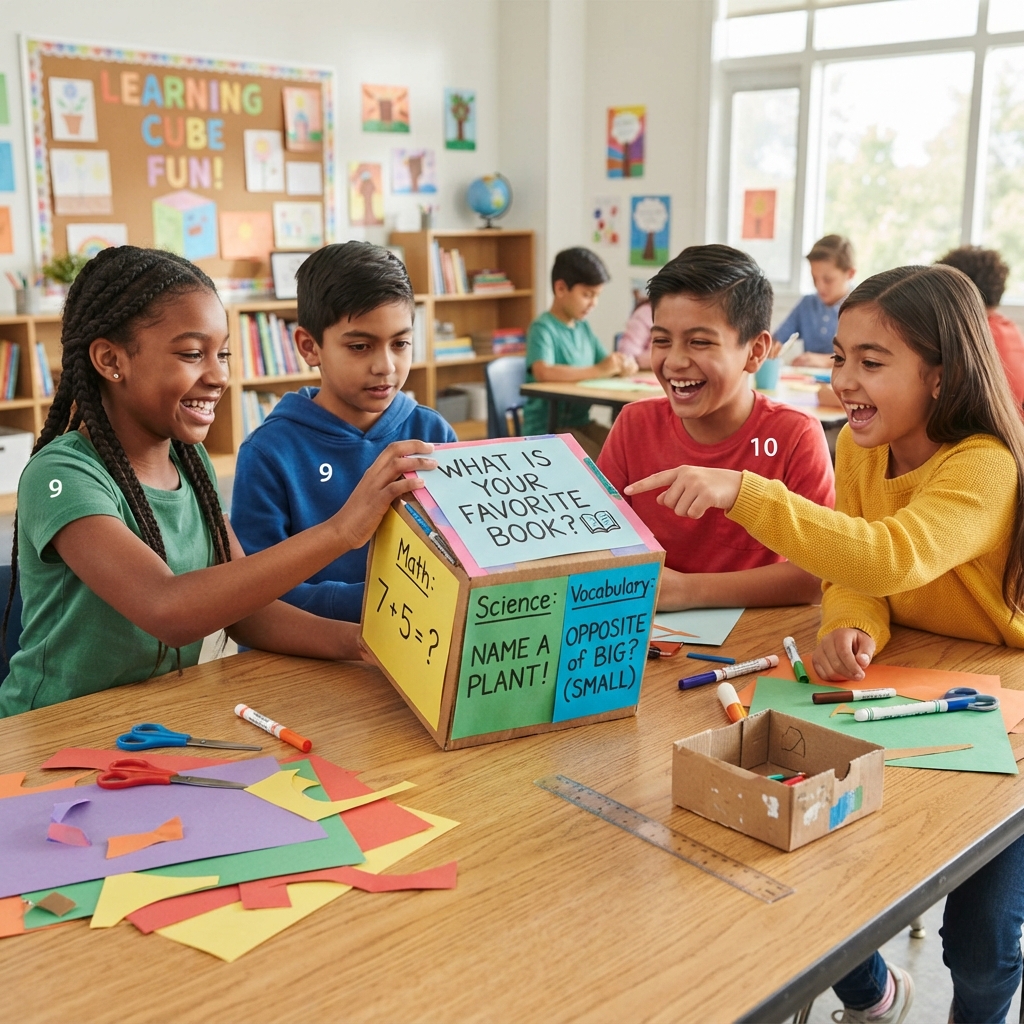
A school question cube is a simple but powerful educational craft that can make classroom learning more interactive, enjoyable, and creative. It is a large or small cube made from cardboard, paper, foam board, or other lightweight materials. Each side of the cube contains a question, a topic, a challenge, or an instruction. Students roll, toss, or choose the cube and then answer the question shown on the upper side.
The school question cube can be used for almost any subject. It can contain questions about mathematics, science, reading, vocabulary, history, geography, or general knowledge. It can also be used for classroom discussions, revision activities, icebreakers, and team games. Because students physically interact with the cube, it turns an ordinary question-and-answer activity into a hands-on learning experience.
The Basic Idea of a School Question Cube
The concept of the question cube is very simple. A cube has six sides, and each side can contain a different question or activity.
For example, a language-learning cube might have questions such as:
- What is your favorite book?
- Name three animals.
- Make a sentence with the word “school.”
- What is the opposite of “big”?
- Spell a difficult word.
- Describe your classroom.
A mathematics cube could contain different calculations or mathematical challenges.
The teacher can create a different cube for every subject or make one general-purpose cube for classroom activities.
Materials Needed

A school question cube can be made with inexpensive materials. Cardboard is one of the best choices because it is lightweight, easy to cut, and strong enough for a classroom craft.
Students can also use colored paper, glue, scissors, a ruler, pencils, and markers. Recycled cardboard boxes are particularly useful.
For decoration, students can use stickers, crayons, colored pencils, paper shapes, or printed labels.
The materials should be selected according to the age of the students. Younger children may need adult assistance when cutting or assembling the cube.
Designing the Cube
Before constructing the cube, students should draw a cube template on cardboard or paper. The template consists of six connected square sections.
Each square should be approximately the same size. Small tabs can be added around the edges to make gluing easier.
Students should carefully measure each section with a ruler.
Once the template is complete, the questions can be planned before the cube is folded. This prevents mistakes and ensures that the content fits properly.
Creating the Six Sides
Each side of the cube can have a different educational purpose.
One side could contain a mathematics question. Another could focus on vocabulary. A third could contain a science question. The remaining sides could include reading, general knowledge, and a creative challenge.
Another option is to use the same subject on all six sides but make the questions increasingly difficult.
This allows teachers to adapt the cube to the learning level of the class.
Adding Color
Color can make the question cube more attractive and easier to use.
Each subject can have its own color. For example, mathematics could use one color, science another, and language another.
The cube can also have colorful borders around each question.
However, the questions should remain easy to read. Decorations should not cover or distract from the text.
Writing the Questions
Questions should be clear and appropriate for the students’ age.
For young children, simple questions such as “What is 2 + 3?” or “Name a fruit” are suitable.
Older students can answer more challenging questions such as “Why does rain occur?” or “What is the main idea of this paragraph?”
Open-ended questions can also be used. Instead of having only one correct answer, students can explain their ideas.
This encourages communication and critical thinking.
Mathematics Question Cube
A mathematics question cube can be an excellent revision tool.
Each side can contain a different type of problem. One side might contain addition, another subtraction, another multiplication, and another division.
More advanced cubes can include fractions, geometry, percentages, or word problems.
For example, a student might roll the cube and receive the question: “What is 8 × 7?”
The student must solve the problem and explain the answer.
This makes mathematics practice more active.
Science Question Cube
Science is another subject that works well with the cube.
Questions can focus on animals, plants, the human body, weather, space, energy, or the environment.
A plant-themed cube might ask students to identify the function of roots, explain why leaves are important, or name different parts of a flower.
A space-themed cube could ask students to name a planet, explain what the Moon is, or describe the Solar System.
The teacher can choose questions based on the current lesson.
Vocabulary Question Cube
A vocabulary cube can help students learn and review new words.
Each side can contain a vocabulary challenge such as defining a word, using it in a sentence, finding a synonym, finding an antonym, or spelling it.
For example, the cube could show the word “happy.” The student might be asked to provide an opposite such as “sad.”
Another side could ask the student to use “happy” in a complete sentence.
This approach develops vocabulary through active participation.
Reading Question Cube
The question cube can also be used after reading a story or passage.
Each side can contain a reading-comprehension question.
Examples include:
- Who is the main character?
- Where does the story take place?
- What problem does the character face?
- What happens at the end?
- What is the main lesson?
- Which part did you like most?
Students roll the cube after reading and answer the question they receive.
This makes reading discussions more engaging.
History Question Cube
A history cube can contain questions about important people, places, events, inventions, or historical periods.
For example, one side might ask students to name an important historical figure. Another could ask why an event was important.
Pictures and dates can also be included.
The cube can be designed around a particular historical topic being studied in class.
Geography Question Cube
Geography questions can focus on countries, continents, oceans, mountains, rivers, cities, or climates.
Students might be asked to name a continent, identify a country on a map, or explain the difference between a river and a lake.
A small map can be placed on one side of the cube.
The teacher can also use the cube during geography revision sessions.
Creative Question Cube
Not every side has to contain a factual question.
Some sides can contain creative challenges.
For example:
- Draw an animal.
- Act like a teacher.
- Make a sentence.
- Tell a short story.
- Describe your favorite place.
- Invent a new classroom rule.
These activities encourage imagination and communication.
Team-Based Learning
The question cube can be used as a team game.
Students can be divided into small groups. One student rolls the cube and answers the question.
If the answer is correct, the team receives a point.
The next student then takes a turn.
Team games encourage cooperation and allow students to help each other.
However, competition should remain friendly. The purpose is to encourage learning rather than create pressure.
Using the Cube as an Icebreaker
A school question cube can be especially useful at the beginning of the school year.
The sides can contain questions that help students get to know each other.
Questions might include:
- What is your favorite subject?
- What hobby do you enjoy?
- What book do you like?
- What would you like to learn this year?
- What is your favorite animal?
- What makes you happy at school?
Students can take turns answering.
This creates a friendly classroom atmosphere and encourages communication.
Benefits for Communication
The question cube encourages students to speak.
Instead of silently completing worksheets, students answer questions aloud.
This helps develop confidence and communication skills.
Teachers can encourage students to answer in complete sentences rather than giving only one-word responses.
The activity can therefore be useful for language development and oral practice.
Developing Critical Thinking
Some questions can have more than one possible answer.
For example, the cube might ask, “How could we make our classroom better?”
Students can suggest different ideas and explain their reasoning.
Such questions encourage critical thinking and creativity.
The teacher can ask follow-up questions to help students develop their ideas.
Improving Memory
The cube can also be used as a revision tool.
Questions can cover information taught during the week.
Students must remember facts and concepts when they roll the cube.
Repeated practice helps reinforce learning.
The physical act of rolling and handling the cube can also make the activity more memorable.
Creating a Reusable Cube
A well-made question cube can be reused many times.
Instead of writing questions permanently on the cube, teachers can attach removable paper cards.
Velcro, reusable adhesive, or small pockets can allow questions to be changed.
This makes one cube useful for different subjects and lessons.
For example, a mathematics cube can be changed into a science cube simply by replacing the question cards.
Making a Pocket Question Cube
Another creative design is to add small pockets to each side.
The teacher can place question cards inside the pockets.
When a student rolls the cube, they take one card from the corresponding side.
This makes the activity more interactive.
It also allows teachers to prepare different sets of questions in advance.
Using Pictures
Pictures can make the cube suitable for younger students.
Instead of writing only questions, teachers can add pictures of animals, objects, foods, plants, or places.
A picture of a cat could lead to a question such as “What animal is this?”
A picture of a tree could lead to “Name two things trees provide.”
Pictures support visual learning and can help students understand questions more easily.
Recycling and Sustainability
The school question cube can be made from recycled cardboard.
Old boxes and packaging can be transformed into an educational game.
This teaches students about reusing materials and reducing waste.
The activity demonstrates that educational resources do not always need to be purchased. Creativity can turn simple household materials into useful classroom tools.
Building the Cube as a Group
Students can work together to create one large question cube.
One group can design the cardboard structure. Another can prepare the questions. Another can decorate the sides.
The teacher can then help assemble the final product.
This encourages teamwork, communication, planning, and responsibility.
Using the Cube in a Classroom Display
A large question cube can become part of a classroom decoration.
It can be placed on a shelf or table with a sign such as “Question of the Day.”
The cube can be rolled each morning, and the question can become a short class discussion.
This creates a daily learning routine.
Adapting the Cube for Different Ages
The difficulty of the questions should match the students’ age and learning level.
For young children, questions can focus on colors, shapes, numbers, animals, and simple vocabulary.
For middle-school students, the cube can contain more complex mathematics, science, grammar, and general-knowledge questions.
Older students can create their own questions for classmates.
This makes the project flexible and suitable for many educational environments.
Conclusion
The school question cube is a simple yet versatile educational craft that can transform classroom questions into an interactive learning experience. Made from cardboard, paper, and other inexpensive materials, it can contain questions about mathematics, science, reading, vocabulary, history, geography, and many other subjects.
The cube encourages students to think, speak, remember, solve problems, and participate. It can be used individually, in pairs, or as a team game. It can also serve as an icebreaker, a revision activity, a classroom decoration, or a daily discussion tool.
Creating the cube provides additional benefits because students practice measuring, cutting, folding, designing, writing, and decorating. Using recycled cardboard also introduces an important lesson about sustainability.
Most importantly, the school question cube demonstrates that learning can be active and enjoyable. Instead of simply answering questions on a worksheet, students can roll a colorful cube, discover a challenge, and respond with their own ideas. This combination of play and education can make lessons more memorable and encourage students to participate with greater enthusiasm.
A simple cardboard cube can therefore become much more than a craft project. It can become a reusable classroom resource that encourages curiosity, communication, creativity, teamwork, and a positive attitude toward learning.
