
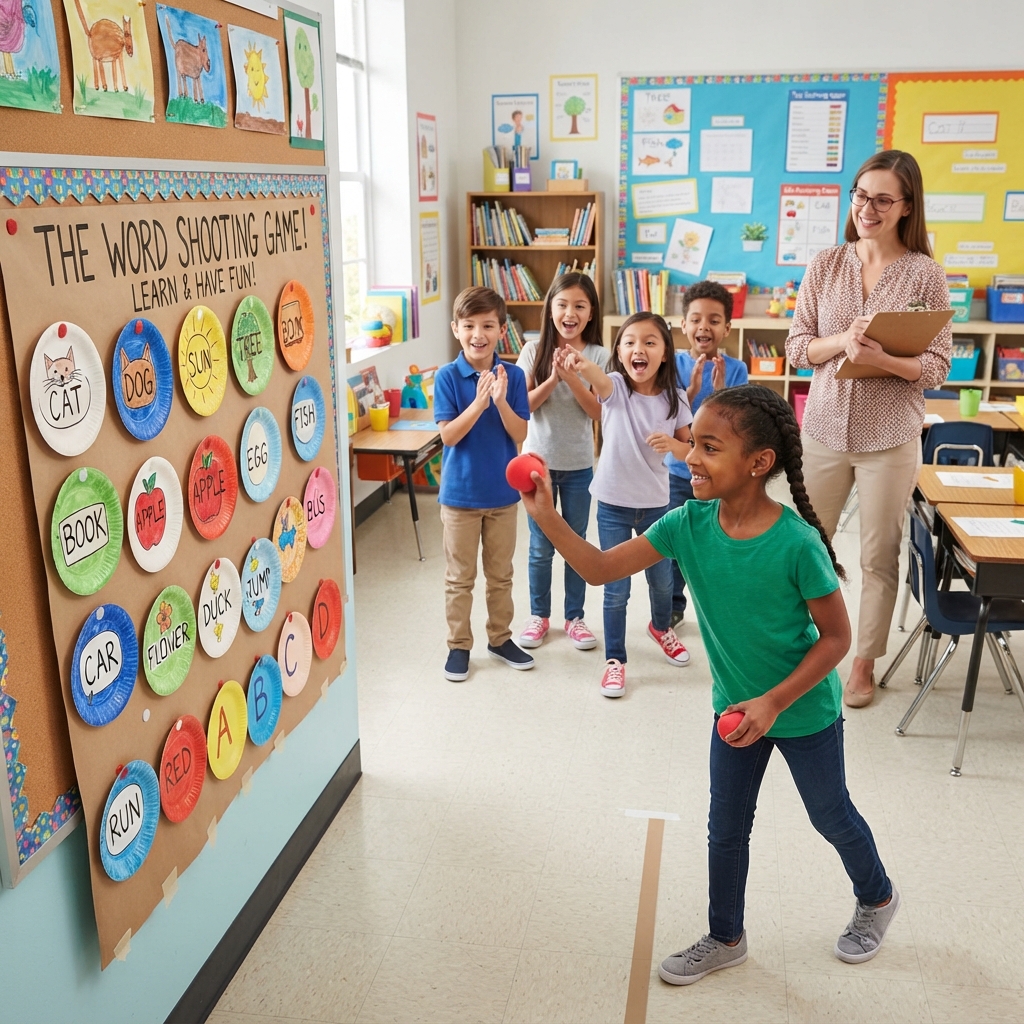
The word shooting game is a creative educational activity that combines language learning, movement, concentration, and friendly competition. It can be designed as a classroom game in which students “shoot” or hit target words using soft balls, paper balls, suction-cup darts, or another safe object. The targets can contain letters, vocabulary words, pictures, numbers, or simple questions. When a player successfully hits the correct target, they earn points or complete a learning challenge.
Although the game is called a “shooting game,” its educational version should always use safe, child-friendly materials. The objective is not to encourage aggressive behavior but to turn learning into an exciting physical activity. Students can practice spelling, reading, vocabulary, pronunciation, grammar, and memory while moving around and trying to reach targets.
The Basic Idea
The word shooting game is based on a simple principle: students must identify a target and hit it correctly. The teacher prepares several targets and places words or letters on them.
For example, the teacher might place the words “apple,” “banana,” “orange,” and “carrot” on different targets. The teacher then gives a clue such as “Find a fruit that is yellow.” The student must identify “banana” and try to hit its target with a soft ball.
Another version can focus on spelling. Several letters can be placed on targets, and students must hit the letters in the correct order to form a word.
This combination of thinking and physical movement makes the activity different from traditional paper exercises.
Materials Needed
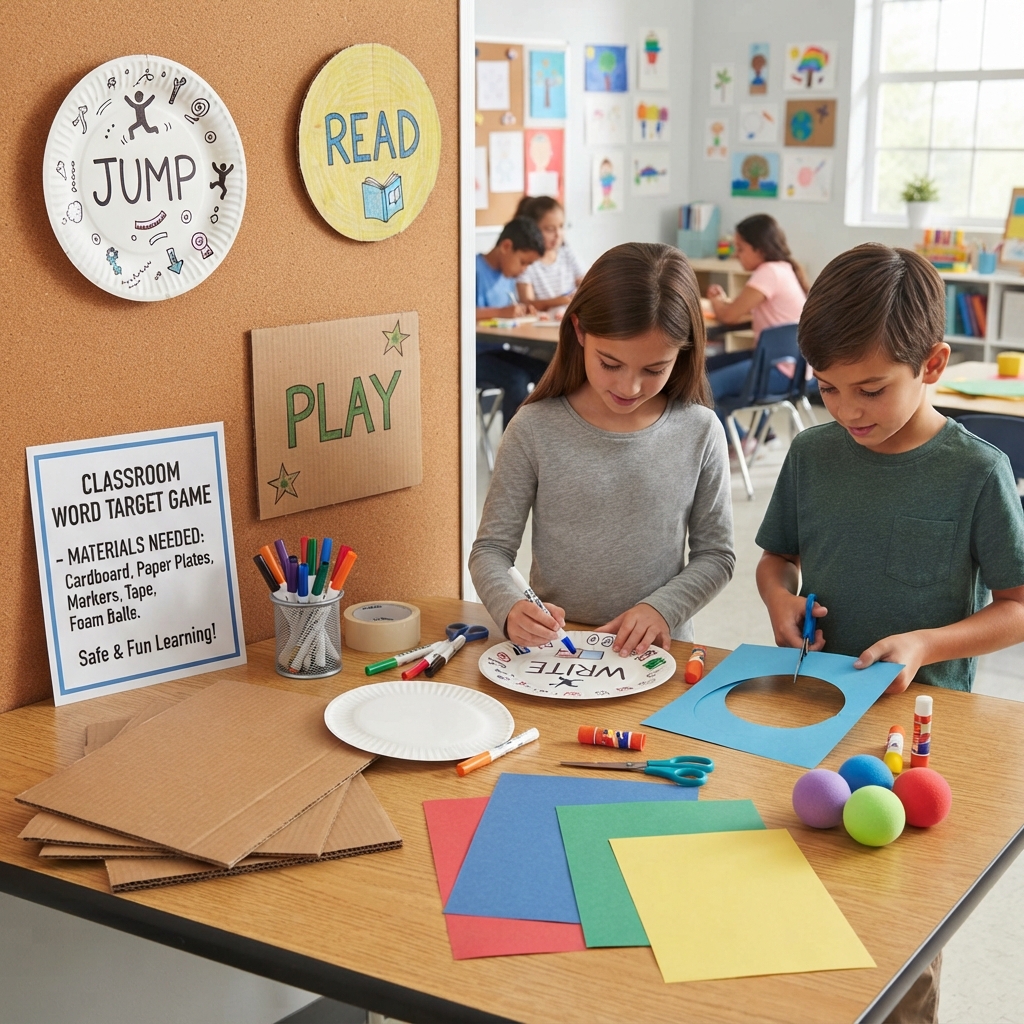
The game can be created with inexpensive classroom materials. Cardboard sheets, paper plates, recycled boxes, colored paper, markers, tape, and soft foam balls are useful.
Targets can be made from cardboard circles or paper plates. Each target can have a large word written in the center.
For a more colorful activity, students can decorate the targets with different colors and simple pictures.
The teacher should choose safe materials appropriate for the children’s age. Hard objects and sharp projectiles should not be used.
Creating the Targets
Making the targets can be part of the educational activity itself. Students can cut or decorate large cardboard circles with adult assistance when needed.
Each target can contain one word, letter, number, or picture.
For vocabulary practice, the teacher can prepare words related to a specific topic. A lesson about animals might include “lion,” “tiger,” “elephant,” “rabbit,” and “monkey.”
A lesson about school objects might include “book,” “pencil,” “desk,” “chair,” and “bag.”
The targets should be large enough to see clearly from the chosen throwing distance.
Setting Up the Game
The targets can be attached to a wall, placed on the floor, or arranged on a large cardboard board.
If the targets are placed on a wall, they should be attached securely. The playing area should be clear of furniture and other obstacles.
Students should stand behind a clearly marked throwing line.
The teacher can explain the rules before beginning.
For example, each player receives three attempts. The teacher gives a word clue, and the player tries to hit the correct target.
Vocabulary Practice
Vocabulary is one of the best uses of the word shooting game.
The teacher can select vocabulary from a current lesson. Students hear a definition, translation, picture clue, or sentence and then identify the correct word.
For example, the teacher could say, “This is an animal that has a long trunk.” The student looks for “elephant” and attempts to hit that target.
This activity requires students to listen carefully and connect meaning with vocabulary.
Spelling Practice
The game can also be used to practice spelling.
Instead of complete words, targets can contain individual letters.
The teacher says a word, such as “CAT,” and the student must hit C, then A, then T.
For older students, longer words can be used.
This turns spelling into a physical challenge and encourages students to remember the correct sequence of letters.
Alphabet Learning
For younger children, the game can focus on alphabet recognition.
Targets can display large letters from A to Z.
The teacher can call out a letter, and the child tries to hit the corresponding target.
Pictures can also be added. A target showing the letter “B” could contain a picture of a ball or banana.
This helps children connect letters with sounds and familiar objects.
Reading Practice
Reading can also be incorporated into the game.
The targets can contain short words or simple sentences. The teacher can read a definition or show a picture, and students must find the matching word.
Another activity involves reading the word before attempting the shot.
For example, the student must say “butterfly” correctly before trying to hit the butterfly target.
This combines pronunciation, reading, and physical coordination.
Grammar Practice
Older students can use the game to practice grammar.
Targets can contain different forms of verbs, nouns, adjectives, or pronouns.
The teacher might give a sentence with a missing word. Students must identify the correct grammatical form and hit its target.
For example, the targets might contain “go,” “goes,” “went,” and “going.” The teacher gives a sentence, and students choose the correct answer.
This turns grammar practice into an active challenge.
Picture-Based Word Shooting
Pictures can make the game especially suitable for younger learners.
Instead of writing only words, teachers can place pictures on the targets.
The teacher names an object, and the student hits the corresponding picture.
For example, pictures of a cat, dog, fish, and bird can be displayed.
This approach is useful for students who are still learning to read.
Scoring the Game
A simple scoring system can make the activity exciting.
Students can receive one point for hitting the correct target. A bonus point can be awarded if they spell or pronounce the word correctly.
The teacher can create different target values. Large targets might be worth one point, while smaller targets could be worth two or three points.
However, competition should remain friendly. The main goal is learning rather than winning.
Team Play
The word shooting game can be played in teams.
The class can be divided into two or more groups. One student from each team takes a turn.
The team earns points when a player correctly identifies and hits a target.
Team play encourages cooperation and allows students to support one another.
It can also reduce pressure on individual students because everyone contributes to the group’s score.
Memory Version
The game can also become a memory activity.
Students are shown several words before the game begins. The words are then covered or mixed with other targets.
The teacher gives a clue, and students must remember where the correct word is located.
This develops memory and concentration while adding a physical element.
Mathematics Integration
Although the activity focuses on words, mathematics can also be included.
Targets can contain numbers or mathematical symbols. Students might need to hit the correct answer to a calculation.
For example, several targets could show numbers such as 8, 12, 15, and 20. The teacher asks, “What is 5 + 7?” The student must hit 12.
This creates a number-shooting version of the same educational game.
Science Vocabulary
Science lessons can benefit from the activity as well.
Targets can contain words such as “plant,” “root,” “stem,” “leaf,” and “flower.”
The teacher gives definitions or clues, and students identify the appropriate word.
For older students, more advanced terms can be used.
The game can therefore become a review activity at the end of a science lesson.
Learning Through Movement
One of the major benefits of the word shooting game is movement.
Traditional classroom activities sometimes require students to remain seated for long periods. A short physical game gives them an opportunity to stand, move, aim, and interact with the learning material.
Movement can help make lessons feel more energetic and enjoyable.
The activity should still be organized carefully so that students move safely and take turns.
Developing Hand-Eye Coordination
The game also develops hand-eye coordination.
Students must look at a target, estimate its position, aim, and throw a soft object toward it.
This requires visual attention and physical control.
The activity should not focus heavily on accuracy. Improvement is more important than perfect performance.
Developing Concentration
Students need to listen carefully to the teacher’s instructions.
If several targets are displayed, they must identify the correct one before throwing.
This encourages concentration and careful listening.
Students can also learn to wait patiently for their turn.
Building Confidence
Some students may feel nervous when speaking or answering questions in front of the class.
A playful activity can make participation feel less formal.
When a student successfully identifies and hits a target, they receive immediate positive feedback.
Teachers can encourage effort rather than only correct answers.
For example, a student who misses the target but correctly identifies the word can still receive praise for understanding the lesson.
Making the Game Inclusive
The activity can be adapted for students with different abilities.
Targets can be placed closer for students who need an easier physical challenge.
Larger targets can also be used.
Students who cannot or do not want to throw can participate by pointing to the correct target, giving instructions to a teammate, or identifying the answer.
This ensures that the educational goal remains accessible to everyone.
Creating Seasonal Themes
The game can be adapted to different seasons and school events.
A winter version could use words such as “snow,” “coat,” “cold,” and “winter.”
A spring version might include “flower,” “rain,” “butterfly,” and “garden.”
During a school celebration, students can create colorful targets related to the event.
This keeps the activity fresh and interesting.
Student-Created Targets
Students can participate in preparing the game.
They can write vocabulary words, draw pictures, and decorate cardboard targets.
Older students can create questions for younger students.
This makes the activity more collaborative.
Creating the targets also provides another opportunity to practice spelling and writing.
Using Recycled Materials
The word shooting game is easy to make from recycled materials.
Old cardboard boxes can become target boards. Used paper can be turned into labels. Empty packaging can provide additional decorations.
This makes the activity inexpensive and environmentally friendly.
Students can learn that educational games do not always require commercially produced equipment.
Safety Rules
Safety should always be the most important consideration.
Only soft, lightweight objects should be used as projectiles. Students should never aim at another person.
The teacher should make sure the playing area is clear.
Only one student should throw at a time, while other students remain in a designated safe area.
The throwing distance should be appropriate for the age and ability of the students.
Clear rules should be explained before the game begins.
Classroom Management
Good organization helps the game run smoothly.
The teacher can create a waiting line and establish a fixed number of attempts for each student.
Students who are waiting can complete another activity, identify words, keep score, or encourage their teammates.
Short rounds are often better than very long games because they keep students focused.
The teacher should make sure every student has a fair opportunity to participate.
Assessment Through Play
The word shooting game can also help teachers assess student understanding.
By observing which targets students choose, teachers can identify vocabulary or concepts that may need more practice.
For example, if several students consistently choose the wrong word, the teacher can review that vocabulary afterward.
This makes the game both entertaining and useful for learning assessment.
Conclusion
The word shooting game is a fun and flexible educational activity that combines language learning with movement, concentration, coordination, and teamwork. Using simple cardboard targets and safe soft materials, teachers can create a game that helps students practice vocabulary, spelling, reading, grammar, pronunciation, mathematics, science terms, and memory.
The activity can be adapted for different ages and abilities. Younger children can shoot at letters and pictures, while older students can work with vocabulary, grammar, definitions, and complex concepts.
Its greatest strength is its ability to transform ordinary review exercises into an active experience. Students listen, think, move, aim, and learn at the same time.
With careful preparation and appropriate safety rules, a cardboard word shooting game can become an engaging addition to the classroom. It shows that learning does not always have to happen at a desk. Sometimes, a simple target, a soft ball, and a few carefully chosen words are enough to turn a lesson into an exciting educational adventure.
