

Making a lobster from colorful beads is a fun and creative craft project for children. With simple pony beads, craft cord, and a little imagination, kids can create a cute lobster inspired by the fascinating creatures of the ocean.
A beaded lobster can become a fun decoration, backpack charm, keychain, or handmade gift. This project is also a great way for children to practice counting, pattern following, concentration, and fine motor skills.
Why Make a Beaded Lobster?
Beading is an enjoyable activity that combines creativity and learning. While making a lobster, children can practice:
- Fine motor skills
- Hand-eye coordination
- Counting
- Color recognition
- Pattern following
- Concentration
- Patience
- Creativity
The project can also introduce children to marine animals and ocean habitats.
Materials You Will Need
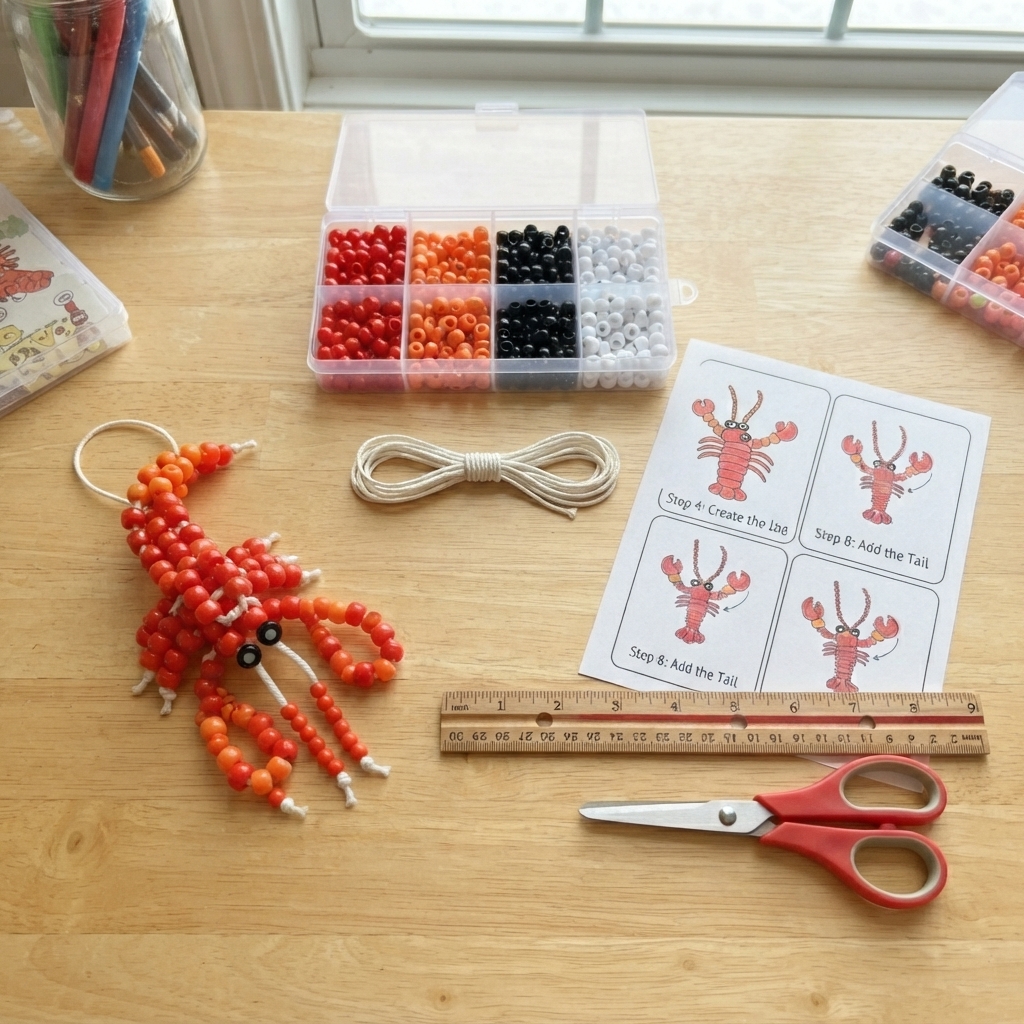
To make a simple beaded lobster, gather:
- Red pony beads
- Orange beads for details
- Black beads for the eyes
- White beads for eye details, if desired
- Craft cord or suitable beading string
- Scissors
- A ruler
- A simple lobster bead pattern
Pony beads are especially useful for beginners because their large holes make them easier to thread.
Safety note: Small beads and craft cords can be choking hazards. Young children should always work under adult supervision. Keep loose beads away from very young children.
Choosing the Lobster’s Colors
Red is a popular color for a lobster craft, but children can experiment with many different combinations.
For a natural-inspired design, try:
- Red and dark red
- Orange and red
- Brown and orange
- Dark blue and black
For a colorful fantasy lobster, try:
- Blue and purple
- Pink and yellow
- Green and turquoise
- Rainbow colors
Let children choose their favorite colors and create a lobster with its own personality.
Step 1: Prepare the Cord
Start by cutting a suitable length of craft cord.
Leave enough extra cord at both ends so you can secure the finished lobster.
Sort the beads by color before beginning.
Place the main body beads in one group and the smaller detail beads in another.
This makes the pattern easier to follow.
Step 2: Create the Lobster’s Body
Begin with the main body.
Thread the beads according to your chosen pattern.
Create a long, slightly rounded body using several rows of beads.
Keep the beads organized as you work.
Do not pull the cord too tightly because the finished lobster needs some flexibility.
Step 3: Make the Head
Continue adding beads to form the lobster’s head.
The head can be slightly wider than the middle section of the body.
Use a darker color if you want to create a contrasting head.
Step 4: Add the Eyes
Use two small black beads for the eyes.
Place them near the front of the head.
For a cute cartoon-style lobster, use white beads with smaller black beads to create larger-looking eyes.
Step 5: Create the Antennae
A lobster has long feelers, which are an important part of its appearance.
Use craft cord or a few small beads to create two antennae.
Keep them long enough to be noticeable but simple enough for a beginner to make.
Secure them carefully.
Step 6: Make the Legs
Lobsters have several walking legs.
Create small beaded legs along both sides of the body.
Try to make the legs similar in size and position.
For a simplified children’s pattern, fewer legs can be used to make the project easier.
Step 7: Create the Large Claws
The claws are the most recognizable feature of a lobster.
Create two larger claws at the front of the body.
Use several beads to give each claw a strong, rounded shape.
Try to make the two claws similar in size, or make one slightly larger for a playful design.
Step 8: Add the Tail
Continue the bead pattern toward the back of the lobster.
Create a wider tail section and gradually narrow it toward the end.
You can use several shades of red or different colors to create stripes.
The tail helps give the finished lobster its characteristic shape.
Step 9: Add Decorative Details
Children can personalize their lobster with colorful patterns.
Try adding:
- Stripes
- Spots
- Colorful claws
- Bright antennae
- Sparkly beads
- A rainbow tail
Every lobster can be different.
Step 10: Secure the Lobster
When the lobster is finished, carefully secure the ends of the cord.
Tie a firm knot and trim away the excess cord.
An adult should check the knot to make sure it is secure.
If the lobster will be used as a keychain or charm, check that the attachment is firmly connected.
Turn the Lobster Into a Keychain
A finished beaded lobster makes a cute ocean-themed keychain or backpack charm.
Attach a suitable keychain ring or clip to a secure point on the lobster.
It can decorate:
- Backpacks
- Pencil cases
- School bags
- Craft bags
Always check that the attachment is secure before using the finished craft.
Creative Lobster Color Ideas
Classic Red Lobster
Use red beads with darker details and black eyes.
Orange Lobster
Combine orange, yellow, and red beads for a bright ocean-inspired design.
Blue Fantasy Lobster
Use blue, turquoise, and purple beads to create a magical sea creature.
Rainbow Lobster
Give each section a different bright color.
This makes a cheerful and unusual lobster.
Pink Lobster
Use pink, purple, white, and yellow beads for a fun fantasy design.
Make a Family of Lobsters
Once children learn the basic pattern, they can make several lobsters.
Create different colors and sizes.
For example:
- A large red lobster
- A small orange lobster
- A blue lobster
- A pink lobster
- A rainbow lobster
Children can give each lobster a name and create stories about their underwater adventures.
Create a Beaded Ocean Scene
The lobster can become part of a larger ocean-themed craft.
Use blue paper or cardboard to create an underwater background.
Add:
- Seaweed
- Coral
- Rocks
- Shells
- Fish
- Starfish
- Turtles
- Octopuses
Place the beaded lobster among the other sea creatures to create a colorful underwater world.
Turn the Craft Into a Learning Activity
Making a beaded lobster is also a great way to introduce children to marine life.
Talk about:
- Where lobsters live
- What lobsters eat
- How lobsters move
- Why lobsters have claws
- How lobsters protect themselves
- Why oceans are important habitats
Children can also count the beads used for the body, legs, claws, and tail.
This makes the project a fun combination of art, science, and mathematics.
Tips for Beginners
Use large pony beads that are easy for children to handle.
Sort the beads by color before starting.
Keep the pattern nearby.
Work on one section at a time.
Count the beads carefully.
Avoid pulling the cord too tightly.
Check the shape regularly.
Ask an adult for help with cutting and tying the cord.
Allow children to experiment with their own colors.
The finished lobster does not need to be perfect. Creativity and enjoyment are the most important parts of the activity.
Common Mistakes to Avoid
Losing Track of the Pattern
Check each row before moving forward.
Pulling the Cord Too Tightly
Too much tension can distort the lobster’s body.
Making Uneven Claws
Compare both claws while working to keep the design balanced.
Forgetting the Antennae
Check the front of the lobster before finishing.
Making the Tail Too Short
A longer tail helps make the lobster’s shape more recognizable.
Using a Loose Knot
A weak knot can cause beads to fall off.
Secure the cord carefully before trimming it.
A Fun Classroom Craft
Beaded lobsters are excellent for classroom craft activities.
Teachers can connect the project to lessons about:
- Ocean animals
- Marine habitats
- Beaches
- Colors
- Counting
- Patterns
Children can create different sea animals and display them together on a large ocean-themed classroom board.
A Handmade Gift Idea
A beaded lobster can make a fun handmade gift for a friend or family member.
Children can choose the recipient’s favorite colors and create a personalized lobster.
Adding a small handmade card can make the gift even more special.
More Beaded Sea Animals to Make
Once children have completed the lobster, they can try making other ocean creatures.
Ideas include:
- Beaded crab
- Beaded dolphin
- Beaded turtle
- Beaded octopus
- Beaded tropical fish
- Beaded starfish
- Beaded seahorse
Together, these projects can become a colorful handmade ocean collection.
Conclusion
Making a beaded lobster is a fun and creative craft project for children. It combines colorful beadwork with opportunities to practice fine motor skills, counting, pattern recognition, concentration, and imagination.
With pony beads, craft cord, and a simple pattern, children can create a classic red lobster, a rainbow lobster, or a completely imaginary underwater creature.
The finished lobster can be used as a decoration, keychain, backpack charm, classroom project, or handmade gift.
Always supervise young children when using small beads and craft cords. With safe materials, simple instructions, and plenty of creativity, a beaded lobster can provide hours of enjoyable crafting and learning.
